
Speech for the launch of the battery materials recovery industry profile at Parliament House
12 March 2026
On 12 March 2026, our Managing Director David Williams-Chen spoke to an audience of industry representatives, parliamentarians and policymakers at Australia’s Parliament House to launch the Battery materials recovery industry profile. This was a report prepared for the Association for the Battery Recycling Industry (ABRI). For details of our project and the report, please see here.
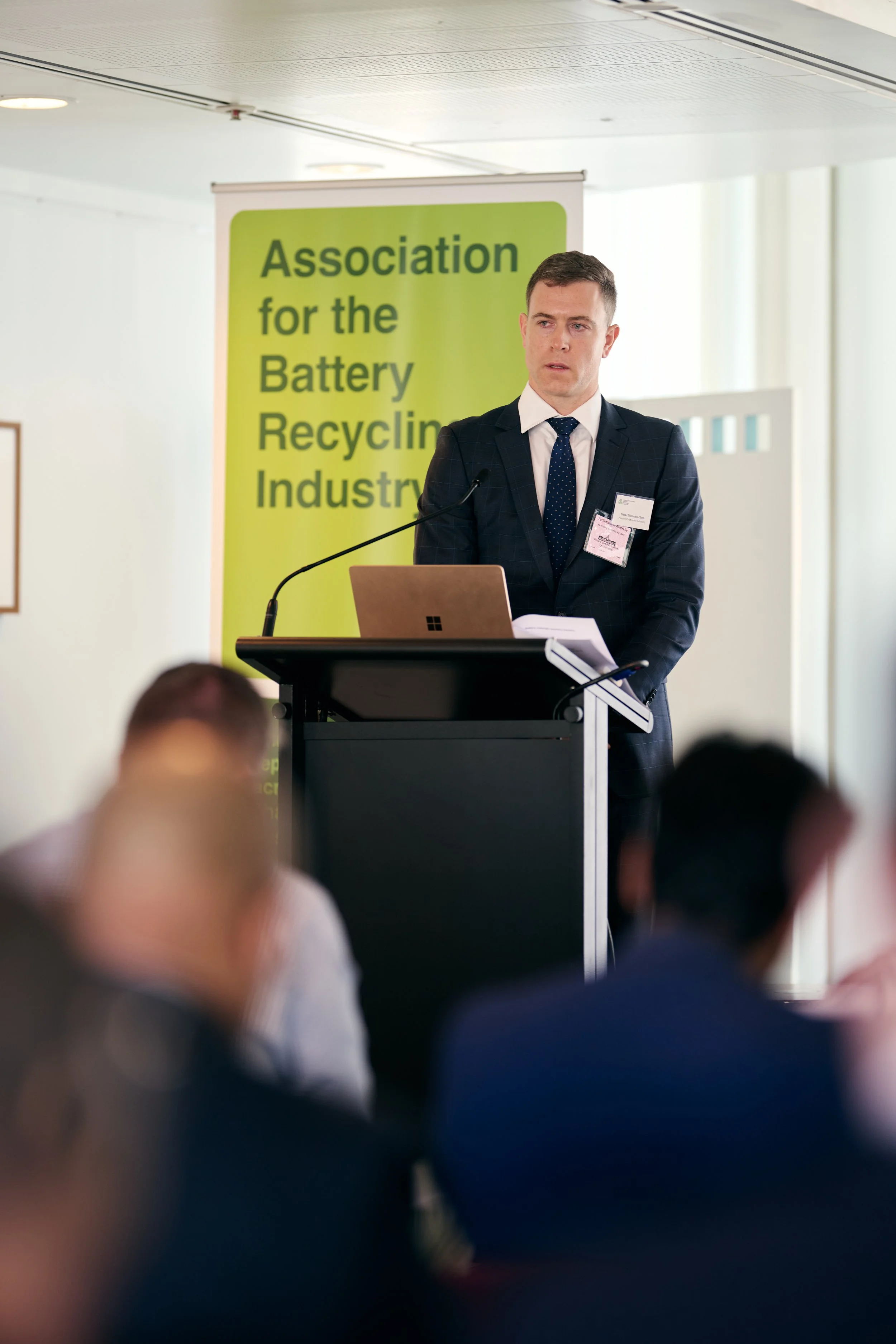
Good morning. It’s a pleasure to be here.
I want to start off with a quiet Australian success story. Every time you turn the key in your car, you’re participating in one of the world’s most successful circular economies. In Australia, we already recycle 99% of used lead-acid batteries. And most of the materials are reused to make new batteries. It is a near-perfect loop where 'waste' is treated as a valuable resource.
Currently, our landscape is dominated by these traditional applications. Automotive and industrial uses make up 73% of battery use in Australia—predominantly in the form of lead-acid batteries. But the composition is changing. Large-scale Battery Energy Storage Systems already account for 20% of the market. These aren't just batteries; they are the giant rechargeable lungs of our grid, storing renewable energy when prices are low and breathing it back when demand is high.
As we stand here today, we are at the edge of a much larger wave. Battery stewardship council data shows that as Australia decarbonises, the rapid uptake of Electric Vehicles and the battery energy storage systems rollout will trigger a 36-fold surge in used lithium batteries by 2050.
This is actually a massive economic gift for our country. In an era of low economic growth and sluggish productivity, battery recycling offers Australia a new economic lever to pull on. By integrating ‘secondary mining’ into our industrial base, we could transform battery materials into a higher-yield, circular-growth engine that complements our traditional resource strengths.
Before I share with you the numbers, I want to touch on how we reached them. Our analysis is built on a rigorous four-step methodology:
First, we surveyed a significant cross-section of ABRI members across the entire supply chain—from sales and collection to sorting and processing. This allowed us to understand the scale of the typical operator in the sector.
Second, we stratified those survey responses and scaled them to estimate the entire national footprint. This approach is very similar to how the ABS would prepare a satellite account for an industry with multiple sectors, such as the tourism sector.
Third, we applied ABS input-output data to estimate the total economic contribution, to understand the indirect, flow-on effects.
Finally, we estimated the future scale of the sector based on the battery stewardship council projections of end-of-life battery volumes. Importantly, we factored in the economies of scale reported by ABRI members on the number of workers and the level of investment required for the sector to expand.
Here’s what we found.
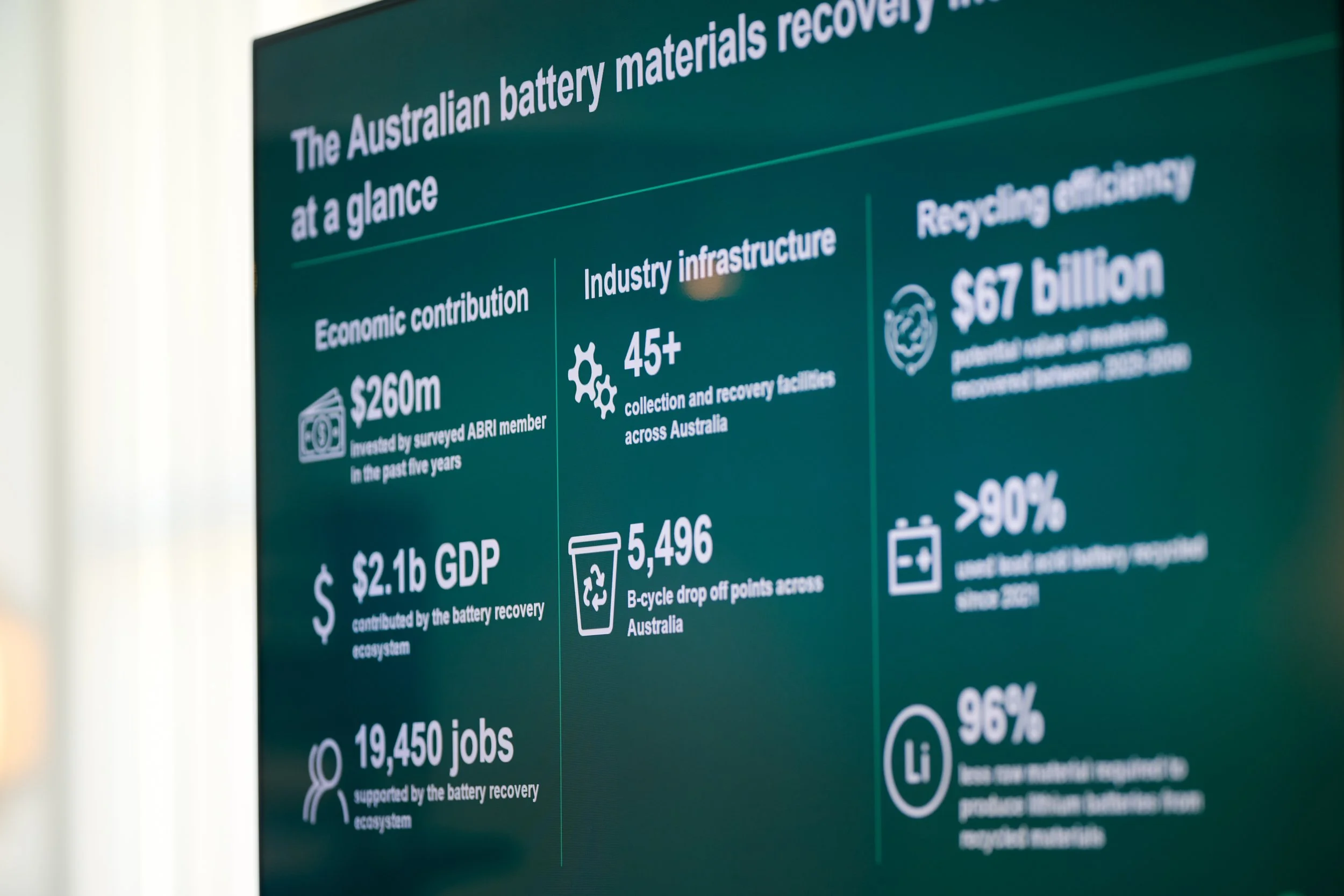
Our analysis shows this sector is a significant economic engine right now. In 2025 alone, the members we surveyed employed over 2,000 people and had sales in excess of $500 million.
When we scale this to the entire sector, we estimate the battery materials recovery ecosystem contributed $2.1 billion to Australia’s GDP. This includes $760 million of direct activity and a further $1.3 billion in indirect activity.
This sector currently supports 19,450 Australians—over 11,000 of them directly. These are skilled roles in logistics, primary processing, and advanced material recovery. We found that the industry paid out $1.4 billion in wages this year alone, supporting families in every state and territory.
Because this isn't just a capital-city industry; this sector lends itself perfectly to supporting regional small business service centres with 45 facilities and 5500 collection points across Australia.
These businesses are betting on Australia as well. In just the last five years, industry players have invested over $260 million in the infrastructure critical to this value chain.
Looking toward the horizon, this sector is a massive productivity lever. To put it in perspective: producing one tonne of battery-grade lithium or cobalt from recovered batteries requires 96% less raw material than traditional mining. We are essentially talking about an industrial shortcut. This isn't just an environmental win; it’s a productivity gain.
Furthermore, between now and 2050, we are sitting on a $67 billion goldmine of recoverable materials. That is $67 billion in value that we can either capture and reinvest in our own economy, or literally throw away.
This brings me to the 'economic prize' of the industry’s future growth. The sector is currently transitioning from a mature, stable lead-acid market into a fast-growing lithium-ion phase.
If we get the policy settings right to capture that $67 billion windfall, by 2050 this industry has the potential to:
Contribute $6.9 billion annually to our GDP—a 300% increase from today.
Support nearly 35,000 jobs across the country.
The industry is ready to scale, but it requires a more supportive policy environment. While the $523 million Battery Breakthrough initiative is a fantastic start for primary manufacturing, the sector needs a 'circular breakthrough' for recovery to close the loop.
To realise that $6.9 billion economic prize, ABRI has recommended three clear policy levers:
A Mandatory National Product Stewardship Scheme: This is a consistent, national framework that makes producers responsible for the entire lifecycle, ensuring a steady, predictable stream of materials for processors.
Enforced Compliance on Hazardous Waste: This would stop the illegal export of used batteries. This isn't just about environmental risk; it’s about preventing the 'leakage' of our sovereign resources overseas.
Establish a framework for EV battery reuse and repurposing to support industry best practice and safety.
So to conclude: This industry is not just about battery recycling it is also a critical mineral sector, a manufacturing sector, and an important economic opportunity for regional and urban Australia alike.
If policy makers and industry can continue to work together, there is potential to make this part of Australia’s energy transition truly circular—protecting our environment and our economic future.