
Addressing Australia’s decade long slump: Why AI is a tool for people, not a replacement
11 May 2026
A recent survey shows that 73% of Australian voters believe AI will have a negative impact on job security. It's not hard to see why, as it seems scarcely a week goes by without another headline heralding the arrival of a new Artificial Intelligence (AI) tool, sparking anxiety about job displacement. Recent headlines, such as Atlassian's 10% workforce reduction to fund AI investments and research, or claims by Anthropic that its latest Claude Mythos model is too dangerous to be released publicly, have fuelled a narrative of an imminent AI‑driven jobs apocalypse.
Why we should look past the fear
In the face of relentless media coverage focused on the specter of mass job displacement, it is understandable that anxiety over AI’s impact is high. Yet, are we asking the right question? Is the core risk truly an 'AI jobs apocalypse,' or are we being distracted from a more fundamental challenge?
In this article, we argue that fears of AI-driven unemployment are overblown and overlook the secondary effects of how technology reshapes labour markets. By examining contemporary evidence and drawing on historical precedent, we find that AI is overwhelmingly an augmentation tool, not an automation tool. Far from destroying work, AI's real promise lies in its capacity to solve our structural productivity puzzle, driving the creation of entirely new products, services, and occupations, many of which we cannot yet imagine.
To understand this shift, this article answers these critical questions:
How can AI help with Australia's current economic challenges?
How does generative AI actually impact the workforce?
Why is the current panic over job losses exaggerated?
How do new technologies historically create wealth rather than destroy employment?
Australia’s current economic challenges and AI’s potential
The pervasive narrative of AI-driven redundancy risks overlooking a more urgent structural weakness in the Australian economy.
The current Australian economic climate is characterised by persistent inflationary pressures, compelling the Reserve Bank of Australia to increase the cash rate target in May 2026.
This move responds to inflation having picked up materially in late 2025. This was driven by greater domestic capacity pressures. The conflict in the Middle East exacerbated this by sharply increasing fuel and commodity prices. Firms are now increasingly passing on cost pressures, and short-term inflation expectations are also rising. This creates materially heightened uncertainties about the near term economic outlook with a potential stagflationary scenario, involving higher inflation and lower domestic economic activity, now being a plausible risk.
Productivity growth has more than halved since 2016.
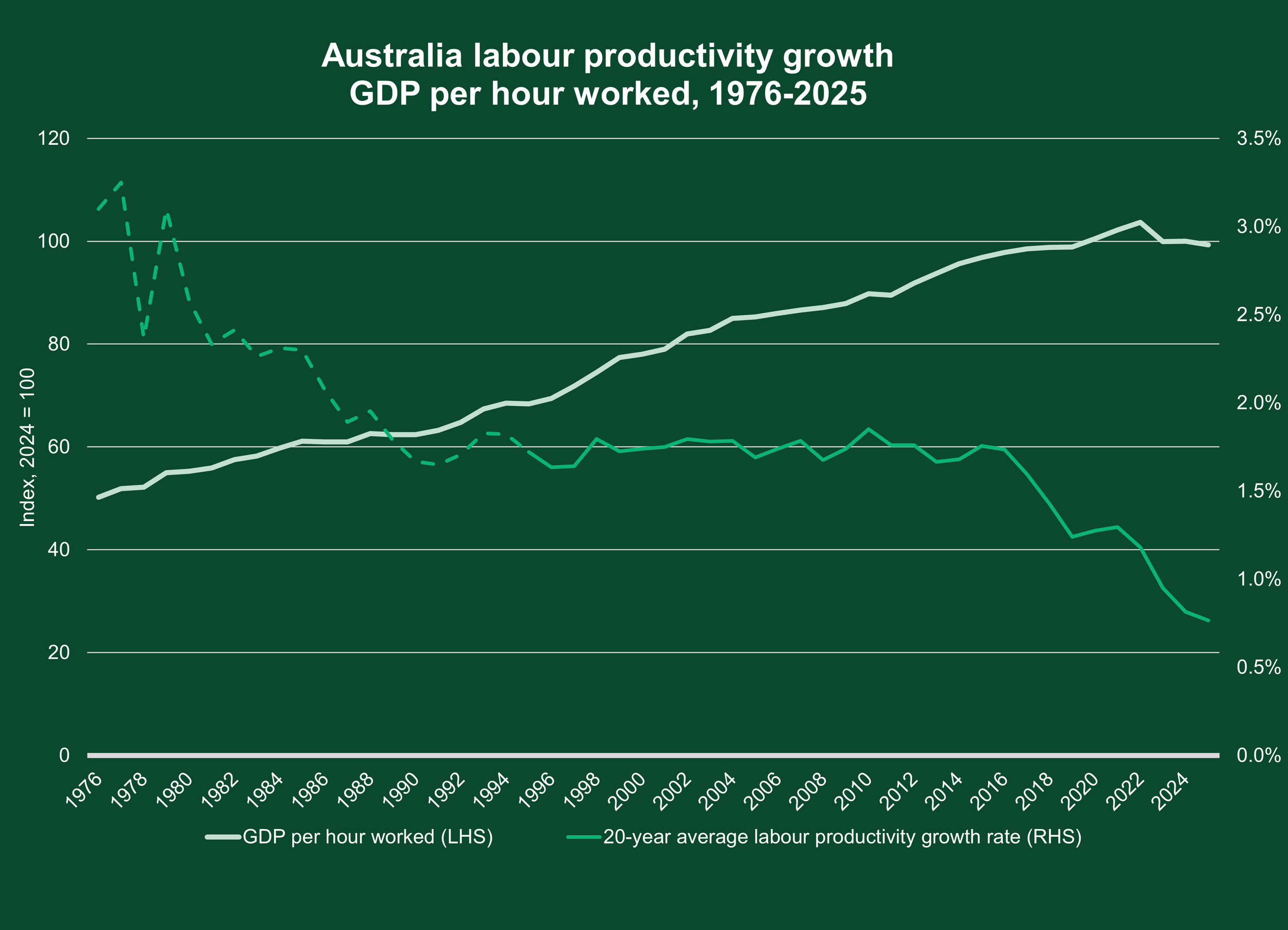
Looking past the immediate challenges reveals a more pressing structural challenge. Productivity growth has more than halved since 2016. Australia’s long-term labour productivity growth has nearly halved over the last two decades, dropping from a 20-year average of 1.8% in 2003-04 to just 0.8% in 2025 (See Figure 1). As labour productivity drives real wages, business profits, and overall living standards, reversing this trend is critical.
AI has the potential to address this problem. Recent Productivity Commission analysis of a range of academic studies estimates that AI could improve multifactor productivity by 0.5% to 13% over the next decade with gains of at least 2.3% being likely. This could translate to an additional 4.3% labour productivity, contributing $116 billion to GDP. On its own, AI adoption will not completely solve the decline in productivity, but on the Productivity Commission's best estimate, it could close one quarter of the gap between the current rates and our historic rates.
Figure 1: Australia labour productivity growth, GDP per hour worked and 20-year average growth rate, 1976-2025.
Generative AI could accelerate worker upskilling
The Productivity Commission has also suggested that Australia's recent productivity slump is partly due to a slowing accumulation of human capital. Supporting this view, recent analysis by the Federal Reserve Bank of Richmond shows that labour productivity growth is driven more by workforce age composition than by the mere introduction of new technology.
Workers aged 35 to 54 have traditionally been the engine of productivity growth because they combine formal skills with deep on‑the‑job experience. It takes years to learn how to deploy tools effectively, redesign workflows, and exercise sound commercial judgement. As a result, lifting aggregate productivity is less about purchasing the latest technology and more about how quickly workers acquire the experience needed to use it well.
If productivity depends on experience and human capital accumulation, the key question is whether any technology can accelerate this traditionally slow process. Generative AI appears uniquely positioned to address this bottleneck by accelerating skill acquisition.
A recent study by Brynjolfsson, Li, and Raymond illustrates how this upskilling mechanism works in practice. Analysing the staggered introduction of a generative AI assistant across 5,172 customer-support agents, the authors find that AI primarily acts as a rapid learning tool, with effects that vary across the workforce:
Rapid upskilling: Productivity gains accrued disproportionately to less experienced workers. Agents with only two months of tenure achieved performance comparable to untreated agents with more than six months of experience.
Durable learning: AI recommendations lead to durable skill acquisition. During software outages, workers maintained productivity gains relative to their pre-AI baseline.
The top-performer trap: AI assistance had little impact on the productivity of the most skilled workers and marginally reduced the quality of their output, suggesting a risk of over‑reliance on algorithms among top performers.
Despite the top performer trap, taken together, these mechanisms increased average worker productivity by around 15 per cent (See Figure 2A).
What does this mean for businesses and workers? Imagine a junior customer service rep in Adelaide. With AI, they can resolve complex issues after only two months in their job whereas without AI they would have needed four more months of experience. AI isn't taking their job; it's giving them a promotion-level skill set on day one. For the business, it's raising their efficiency.
Figure 2A and 2B: Raw productivity distributions by AI Treatment, measured in resolutions per hour and average handle time
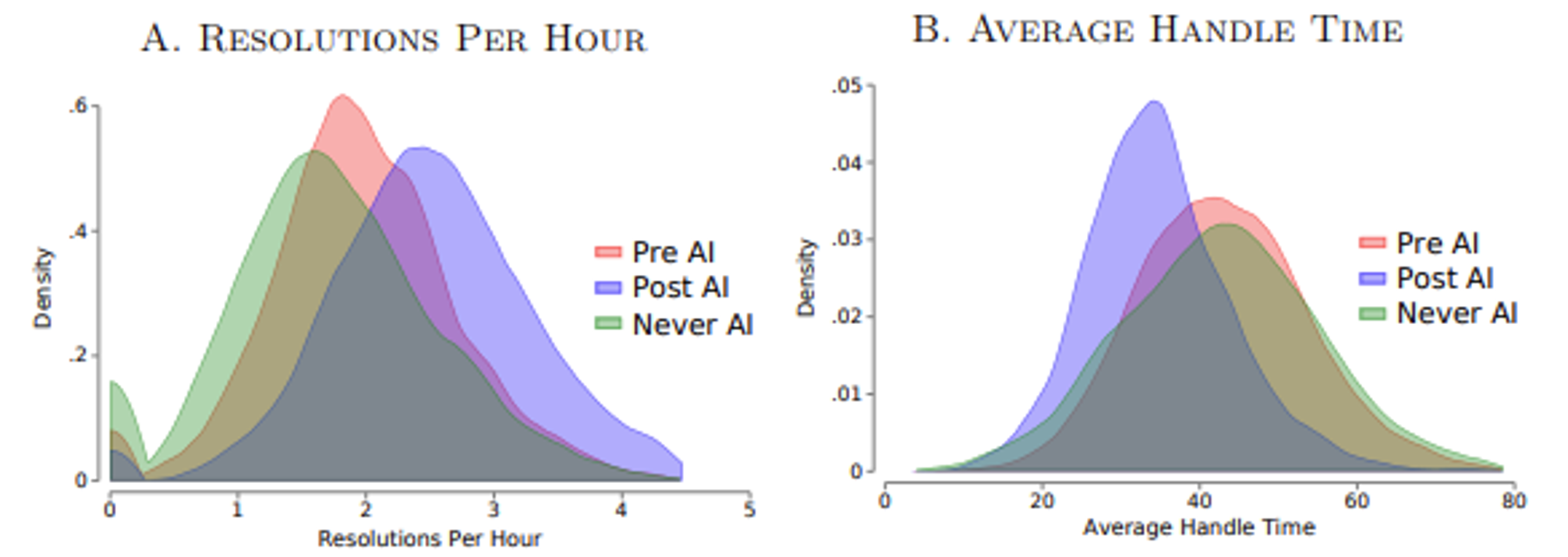
Note: Pre AI = Agents who receive access to the AI system before deployment; Post AI = Agents who receive access to the AI system after deployment; Never AI = Agents who never receive AI system access.
Source: Brynjolfsson, E., Li, D., & Raymond, L., 2026. Generative AI at Work, The Quarterly Journal of Economics, Link.
This micro-level evidence of worker efficiency aligns closely with broader macroeconomic research into firm behaviour. A recent 2024 study by Babina et al. found that AI-investing firms experience higher growth in sales, employment, and market valuations. Crucially, this growth comes primarily through increased product innovation. AI appears to be empowering firms to create new products and expand their market offerings, rather than merely automating existing processes to cut costs.
Current tech layoffs are driven more by macroeconomic cycles than AI
Despite these productivity gains, concerns persist that AI will ultimately displace human workers, with layoffs at major technology firms frequently cited as evidence. However, macroeconomic indicators suggest these redundancies are better explained by broader market cycles than by AI-driven automation. The current "tech bust" is largely the result of a post-pandemic correction, higher interest rates slowing business IT investment, and a shift towards outsourcing. Rather than AI actively replacing human engineers, the technology has, until very recently, simply been too primitive to genuinely replicate high-level cognitive work.
Nearly four years after the release of ChatGPT, only one-third of the workforce has actually adopted AI in their day-to-day routines
Additionally, major technology breakthroughs take time to implement and integrate in the workplace. Nearly four years after the public release of ChatGPT, a survey revealed that only about one-third of the workforce has actually adopted AI in their day-to-day routines. This shows much of the potential upside is still yet to be achieved.
Why the fear of job losses from AI is overblown
A longer historical view reinforces the conclusion that fears of technology‑driven job loss are often overstated.
60% of employment in 2018 concentrated in job titles that did not exist in 1940
Research analysing eight decades of technological change demonstrates that innovation creates new demands for human expertise; roughly 60% of employment in 2018 concentrated in job titles that did not exist in 1940.
Past tier‑one technological shifts rendered specific roles obsolete, but they also raised overall wealth, expanded the set of profitable business activities, and created entirely new occupations. This dynamic is also visible in contemporary classification systems. In Australia, the Australian Bureau of Statistics occupation classifications are periodically revised to reflect the emergence of new job titles as technologies, industries and social needs evolve (see Figure 3).
Figure 3: Examples of new occupations added to the Australian Bureau of Statistics’ occupation classification list
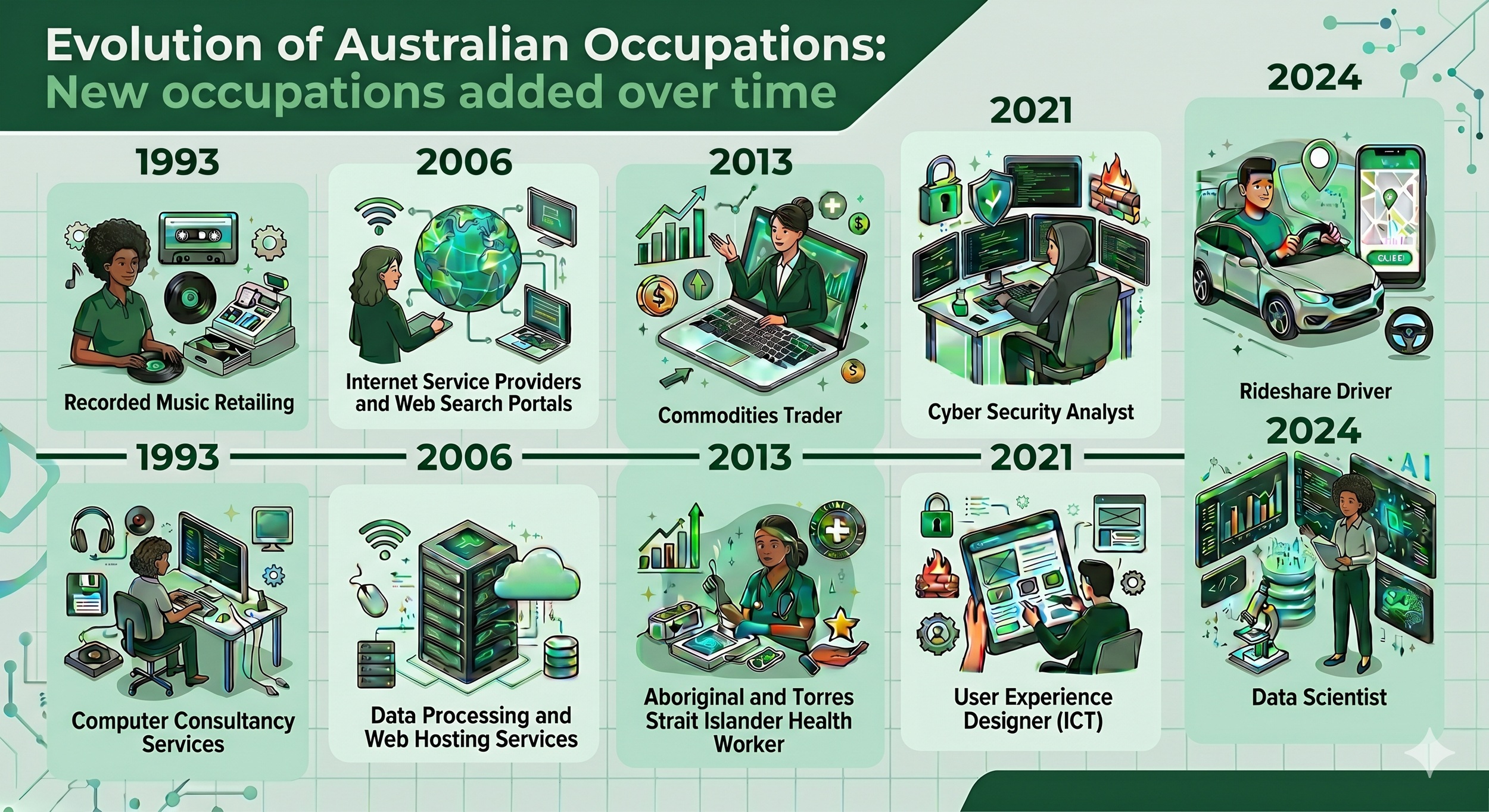
Note: ANZSIC = Australian and New Zealand Standard Classification of Occupations; OSCA = Occupation Standard Classification for Australia
Source: ABS, 1993, 2006, 2013, 2021. Australian and New Zealand Standard Industrial Classification (ANZSIC); ABS 2024. Occupation Standard Classification for Australia.
Our view is that AI is not an historical anomaly, but the latest instance of this recurring pattern.
Early labour‑market evidence supports this view. Job availability in Australia grew by 10% in roles highly exposed to AI. Degree requirements for these roles are also falling, suggesting AI could lower barriers to entry for non-traditional talent. Furthermore, AI is making workers more valuable, with AI-skilled workers globally enjoying an average 56% wage premium.
Managing the transition requires targeted support
This is not to say the transition will be painless. While AI will largely augment rather than automate jobs, the distributional impacts will be uneven. For instance, older white-collar workers (aged 58 and over) are the least likely to engage with AI tools, exposing them to significant transition risks. Women are also slightly more exposed to changes in their current roles, with the ILO finding that occupations with the highest automation exposure employ more women than men.
Policymakers and corporate leaders must approach this shift with empathy, providing targeted retraining and support to ensure these vulnerable cohorts are not left behind:
Upskill junior staff: Leverage AI as a training tool to upskill entry-level staff and reduce the costly "ramp-up" time for new hires, rather than just automating headcount.
Support vulnerable demographics: Implement targeted retraining and change-management programs, particularly for older workers facing higher transition risks.
Protect top-performer innovation: Ensure leading experts continue to exercise the high-quality human judgment that algorithms rely on to learn.
Drive product innovation: Deploy AI to drive the creation of new products, services, and market value, rather than simply cutting costs.
Leveraging AI for economic growth
Far from presenting an existential threat to employment, AI offers a powerful solution to Australia’s long-term productivity challenges. The evidence strongly suggests AI is primarily an augmentation tool, accelerating skill acquisition, driving innovation, and creating entirely new categories of work, consistent with historical technological shifts. In 1993, we didn’t know we needed 'Computer Consultants'; today, we can't imagine life without 'Data Scientists.' AI based occupations are simply the next driver in the evolution of our workforce.
By focusing on targeted support for vulnerable groups and leveraging AI to expand market offerings rather than merely cut costs, we can harness this technology to unlock significant economic growth, raise living standards, and secure a more prosperous future for all Australians.
Sources:
Atlassian, 2026. An important update on our team, Link.
Australian Bureau of Statistics, 2025. Australian System of National Accounts, Link.
Babina, T., Fedyk, A., He, A., & Hodson, J., 2024. Artificial intelligence, firm growth, and product innovation. Journal of Financial Economics, Link.
Brynjolfsson, E., Li, D., & Raymond, L., 2025. Generative AI at Work, The Quarterly Journal of Economics, Link.
Hashim, Shakeel, 2026. Anthropic’s new AI tool has implications for us all – whether we can use it or not, Link.
Henry, Erin, Pierre-Daniel G. Sarte and Jack Taylor, 2024. The Productivity Puzzle: AI, Technology Adoption and the Workforce, Link.
Jobs and Skills Australia, 2025. Our Gen AI Transition, Link.
Mizen, Ronald, 2026. Westpac chief Anthony Miller urges Jim Chalmers to chase AI upside, Link.
Productivity Commission, 2025. Harnessing data and digital technology Interim report, Link.
Productivity Commission, 2026. Annual productivity bulletin 2026, Link.
PwC, 2025. The Fearless Future: How AI is impacting Australia’s jobs and workers, Link.
RBA, 2026. Statement by the Monetary Policy Board: Monetary Policy Decision, Link.
Seegmiller, Bryan, 2022. New Frontiers: The Origins and Content of New Work, 1940–2018, Link.
The Economist, 2026. The tech jobs bust is real. Don’t blame AI (yet), Link.